
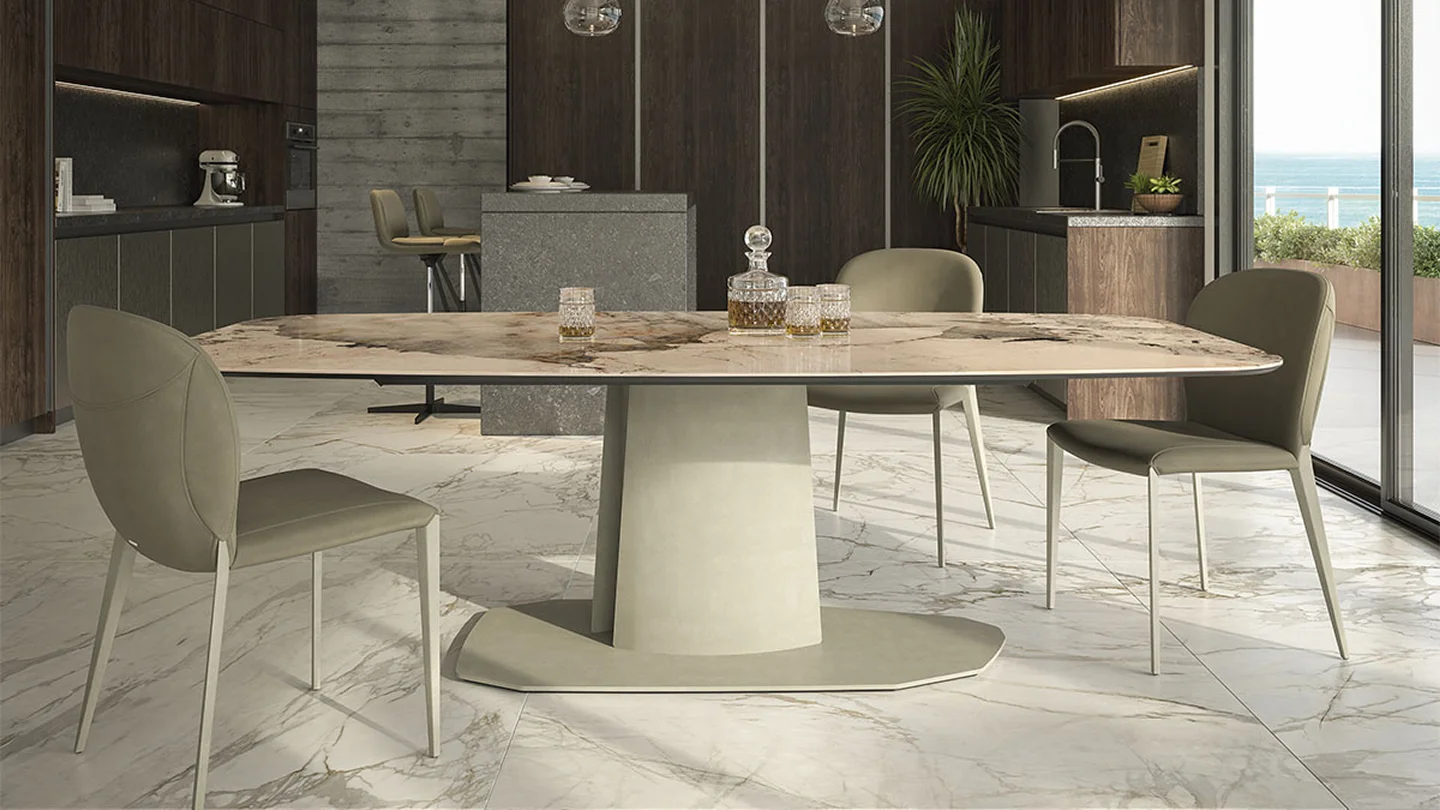
The dining table is becoming more than a place reserved for meals. It may host breakfast before work, become an informal workspace during the day and bring family or friends together in the evening. As the way we use the dining room changes, the table has to respond with the right combination of proportion, material and flexibility.
Current dining table trends reflect this shift. Sculptural bases, softer silhouettes, natural materials and adaptable designs are increasingly influencing contemporary interiors. At Milan Design Week 2026, tables with architectural bases, expressive stone and organic forms were particularly visible, reinforcing the table’s role as a defining element within the room.
For indian homes, however, the best choice still begins with how the space is actually used.
Sculptural Bases Are Giving Tables More Presence
One of the clearest directions for 2026 is the move towards tables that make an impact below the tabletop.
Instead of four conventional legs, designers are exploring pedestal structures, geometric forms and architectural bases. Wallpaper* identified sculptural tables as a recurring theme at Salone del Mobile 2026, where bases were treated almost as standalone pieces of architecture.
This approach is particularly visible across Ventura’s Cattelan Italia and Eforma collections. Cattelan Italia uses distinctive bases alongside wood, ceramic, glass and stone surfaces, while Eforma’s dining tables often combine sculptural supports with marble or Crystal Ceramic tops.
Among contemporary dining table designs, this works particularly well when the table is visible from several directions in an open-plan home.
Curves Are Softening the Dining Room
Rectangular tables remain useful, especially in longer rooms, but they are no longer the only default.
Oval, round and organically shaped tables are becoming more prominent. Livingetc identifies organic forms as one of the significant table directions for 2026, while wider furniture trends are also moving towards softer, curved silhouettes.
So, what is the best shape for a dining table? It depends on the room.
Round tables encourage conversation and can work well in compact or square dining spaces. Oval tables provide some of the seating capacity of a rectangle while creating softer circulation around the edges. Rectangular tables remain practical for larger families and longer rooms.
The best shape is therefore the one that gives chairs enough space to move while keeping circulation comfortable.
Natural Materials Are Taking Centre Stage
Material is another major influence on today’s dining rooms.
Design coverage from 2026 points towards a renewed appreciation for natural stone, wood and surfaces that reveal their inherent texture rather than concealing it. ELLE Decor notes increasing interest in solid oak, walnut and natural stone within current dining rooms, while Architectural Digest highlighted both stone and wood prominently at Milan Design Week.
For anyone choosing an italian dining table, this opens up several possibilities.
A wood top introduces warmth and works comfortably across a wide range of interiors. Marble offers natural variation and stronger visual presence. Ceramic surfaces can provide a stone-like appearance with practical performance, while glass creates visual lightness and reveals more of a sculptural base underneath.
There is no single best material for every tabletop. The right choice depends on how frequently the table is used, the maintenance you are comfortable with and the other materials already present in the room.
Extendable Tables Are Making Space Work Harder
Dining rooms are rarely used the same way every day.
A table that comfortably seats four or six may need to accommodate a much larger group when friends or family visit. This makes extendable furniture particularly useful in urban homes where permanently accommodating the maximum number of guests may not be practical.
Poliform’s Henry table, available through Ventura, is one example. Its solid wood structure can be paired with wood, marble or glass tops, with an extendable version providing additional flexibility for larger gatherings.
When selecting dining room furniture, it is worth planning around everyday requirements first and occasional entertaining second. An adaptable table can provide additional capacity without overwhelming the room on an ordinary day.
Dining Tables Are Becoming the Statement Piece
One answer to the question “What table design is trending now?” is increasingly clear: the table itself is being allowed to become the focal point.
Rather than filling the dining room with several competing elements, a distinctive table can establish the character of the space while chairs, lighting and storage take on quieter supporting roles.
Cattelan Italia’s Stratos collection, for example, combines a sculptural base with options across wood, ceramic and decorative glass surfaces. Bontempi Casa similarly places a strong emphasis on contemporary dining tables, including designs that combine expressive metal structures with ceramic, marble-inspired and other material finishes.
This does not mean every italian dining table needs to be visually dramatic. A simpler form can have equal presence when its proportions and material are carefully considered.
Dining Furniture Is Becoming Less Matched
Another change influencing dining table designs is the move away from buying the table, chairs and storage as one matching set.
Instead, homeowners are creating more layered combinations. A stone table may be paired with upholstered chairs. A strong architectural base might sit alongside visually quieter seating. Timber can be repeated in a nearby sideboard without requiring every finish to be identical.
This approach allows dining room furniture to feel connected without appearing overly coordinated.
It can also make a dining room feel more personal. Rather than following a fixed collection, individual pieces are selected for how they relate through proportion, material or colour.
What Are the Dining Table Trends for 2026?
The strongest dining table trends for 2026 centre on sculptural form, organic shapes, natural materials and greater flexibility. Rather than decoration for its own sake, current design is giving character to the table through construction, texture and proportion.
For contemporary indian homes, these ideas work best when adapted to the room rather than followed literally.
Before selecting a table, measure the usable dining area, account for chairs and circulation, and consider how often the space needs to accommodate additional guests. Ventura recommends allowing approximately 90 cm between the table edge and a wall or fixed object as a useful starting point for circulation.
At Ventura Interiors, our Bengaluru and Hyderabad showrooms bring together dining collections from brands including Poliform, Cattelan Italia, Bontempi Casa and Eforma, making it possible to compare shapes, materials and finishes in person.
Ultimately, the best dining table designs are not defined by trend alone. The right table should give the room presence while still making everyday dining, movement and conversation feel effortless.
0 Comments